


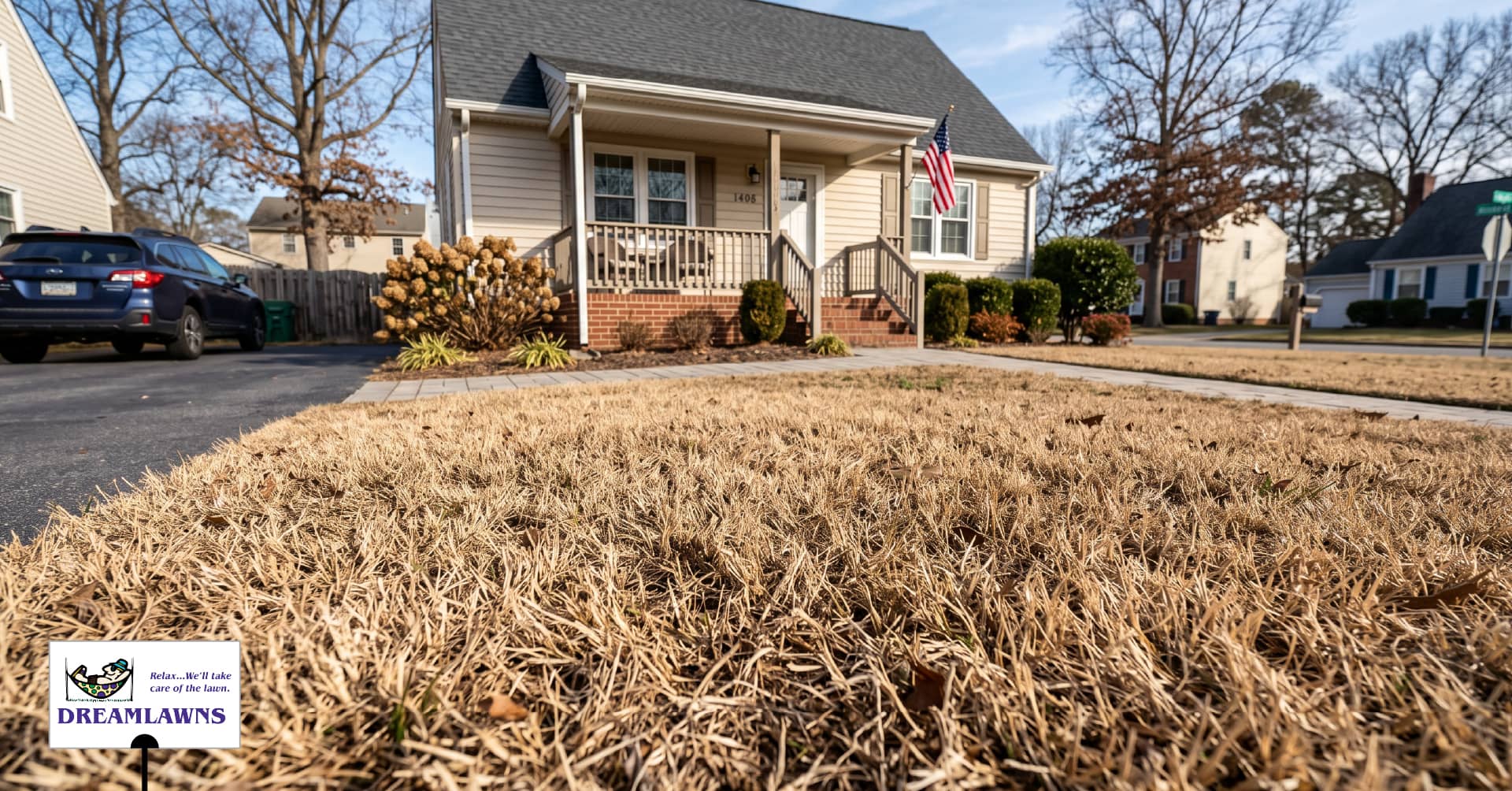
Dreamlawns Quick Cut: Overseeding dormant Bermuda with ryegrass gives you green color through winter, but it comes with real trade-offs. The ryegrass competes with Bermuda as it tries to green up in spring, can weaken the Bermuda stand, complicates the spring transition, and adds a full winter of extra mowing and maintenance. In a transition-zone climate like Virginia Beach, where Bermuda is already near its limits, the cosmetic benefit usually isn’t worth the cost to the lawn’s long-term health.
Every winter, Bermuda lawns across Virginia Beach go dormant and turn brown. It’s completely normal and healthy, but not everyone loves looking at a tan lawn for months. That’s where winter overseeding with ryegrass comes in: sow a cool-season grass over the dormant Bermuda in fall, and you get a green carpet through the cold season instead of dormant brown.
It sounds appealing, and it’s a heavily marketed practice. But there’s a reason many turf professionals advise against it for home lawns, especially in a transition-zone climate like ours. The green winter color comes at a genuine cost to the Bermuda underneath, and that cost tends to show up right when the lawn is most vulnerable, during spring green-up.
This is an honest look at whether overseeding Bermuda with ryegrass is actually worth it. We’ll cover the real reasons some people do it, the significant downsides, and why for most Virginia Beach homeowners, the answer leans toward no.
What Is Winter Overseeding With Ryegrass?
Winter overseeding is the practice of planting a cool-season grass into a dormant warm-season lawn to provide green color during the cold months. Bermuda is a warm-season grass that thrives in summer heat and goes dormant, turning brown, once temperatures drop below about 50°F in fall. Ryegrass, by contrast, is a cool-season grass that grows actively in the milder temperatures of fall, winter, and early spring.
By sowing ryegrass over dormant Bermuda in early fall, the ryegrass germinates and stays green and actively growing through the winter, right when the Bermuda is brown and inactive. The two grasses essentially trade places seasonally: ryegrass carries the color through winter, and Bermuda is meant to take back over in spring as temperatures warm.
There are two types of ryegrass used for this. Annual ryegrass is cheaper, coarser, and dies off on its own as temperatures rise in spring. Perennial ryegrass is finer and more attractive but more persistent, which can make the spring transition harder because it doesn’t give up its ground as readily. Either way, winter overseeding is fundamentally a cosmetic practice: its purpose is winter color, not lawn health.
Why Do Some Homeowners Overseed Bermuda With Ryegrass?
To be fair, there are legitimate reasons people choose to overseed, and it’s worth understanding them before getting into the downsides. The practice does deliver some genuine benefits.
- Green winter color: The main draw. Instead of dormant brown from late fall through early spring, the lawn stays green and lush-looking through the cold season, including the holidays.
- Curb appeal: For homeowners who place a high value on a green lawn year-round, the cosmetic boost through the off-season is real.
- Erosion control: On slopes or bare, thin areas where dormant Bermuda offers little cover, actively growing ryegrass can help stabilize soil against winter rain.
- Winter usability: An actively growing turf surface holds up to winter foot traffic better than dormant Bermuda, which is part of why the practice is common on some athletic fields and high-use commercial properties.
These benefits are real, and for certain high-visibility or high-use properties they can justify the practice. But for a typical residential Bermuda lawn, they have to be weighed against a set of downsides that are easy to overlook when you’re just picturing a green winter yard. That’s where the honest accounting gets less flattering.
What Are the Real Downsides of Overseeding Bermuda With Ryegrass?
The core problem with winter overseeding is that the ryegrass doesn’t politely step aside when spring arrives. It lingers and competes with the Bermuda at the worst possible time, and that competition drives most of the downsides.
- Spring competition with Bermuda: This is the big one. As Bermuda tries to break dormancy and green up in spring, the still-active ryegrass competes with it for sunlight, water, and nutrients. This competition directly delays the spring transition from ryegrass back to the warm-season grass, and the ryegrass canopy shades and cools the soil, slowing the Bermuda’s green-up when it’s most vulnerable.
- Weakening the Bermuda stand: Repeated year-after-year overseeding stresses the Bermuda and can thin it over time. Improper spring transition, when the ryegrass hangs on too long or dies off unevenly, can cause direct Bermuda dieback. And even in a clean transition, the summer quality of the Bermuda is often diminished for weeks after the ryegrass is gone, since the underlying turf spent months competing for light, water, and nutrients rather than establishing on its own.
- A difficult, unpredictable spring transition: Getting the ryegrass to exit cleanly is genuinely tricky. If spring is cool and wet, the ryegrass persists longer and can cause permanent damage to the warm-season lawn. The transition is at the mercy of the weather in a way that a dormant, non-overseeded lawn simply isn’t.
- A full winter of added maintenance: Ryegrass grows through the winter, which means you’re mowing all winter long when a dormant Bermuda lawn would need no mowing at all. It also needs its own watering and fertilization. Overseeding reliably requires more time, more money, and more effort across the whole cool season.
- Extra risk for already-stressed lawns: If your Bermuda already deals with spring dead spot, thin shaded areas, or thatch issues, adding ryegrass hides the winter brown while making spring recovery harder, and can compound existing problems rather than help them.
- Conflicts with standard weed control programs: Most managed Bermuda lawns, including those on Dreamlawns’ programs, receive fall pre-emergent applications that prevent winter weed germination. Those same pre-emergents also prevent ryegrass from germinating, so overseeding requires skipping the fall pre-emergent round. That skip has consequences. Without the fall pre-emergent barrier, winter weeds like annual bluegrass (Poa annua), chickweed, and henbit have an open path to establish in the lawn. On the spring side, the post-emergent herbicides used to control winter weeds will also damage or kill ryegrass. The post-emergents can actually be used intentionally to transition the ryegrass out of the lawn in spring, but the tradeoff is that the ryegrass will be visibly damaged and dying during that window rather than exiting cleanly on its own.
Why Is This Especially Risky in Virginia Beach?
Winter overseeding is far more common, and far more defensible, in the Deep South than in a transition-zone climate like Virginia Beach. That distinction matters a lot, and it’s the main reason we’re cautious about the practice here.
In places like Florida, Georgia, and the low desert Southwest, winters are mild, and Bermuda is well within its comfort zone. Virginia Beach sits in the transition zone, where Bermuda is closer to the cold edge of where it can thrive. Our Bermuda lawns already work harder to survive winter and green up in spring than Bermuda in the Deep South does, and the spring green-up here is a more delicate period as a result.
Layering ryegrass competition on top of an already-delicate spring transition is a bigger gamble in Virginia Beach than it would be further south. A cool, wet Virginia Beach spring, which is common, is exactly the scenario that lets ryegrass persist and do lasting damage to the Bermuda. Anything that weakens Bermuda as it comes out of dormancy carries more risk here, because our Bermuda has less margin to spare. The same practice that’s a reasonable cosmetic choice in Georgia is a riskier proposition on a Virginia Beach lawn.
Winter overseeding also conflicts with the weed control programs that keep most Virginia Beach Bermuda lawns clean through the cool season. Skipping fall pre-emergent to allow ryegrass to germinate opens the door to a winter of Poa annua, chickweed, and henbit pressure that a properly timed pre-emergent would have prevented. On a managed lawn, that’s a real cost that doesn’t get factored into the “just add ryegrass” pitch.
What Are the Alternatives to Winter Overseeding?
If the goal is a healthy Bermuda lawn, the best alternative to winter overseeding is usually to skip it and manage dormancy well instead. Here’s what that looks like.
- Understand and accept dormancy: Dormant Bermuda is not dead Bermuda. The brown is a normal, healthy survival state, and the lawn greens back up on its own in spring. Knowing the difference takes the worry out of a tan winter lawn. Our guide on dormant versus dead grass walks through how to tell.
- Prepare Bermuda well in fall: A Bermuda lawn that enters winter healthy, with strong roots and good potassium levels, comes through dormancy better and greens up faster and stronger in spring. Good fall preparation does more for spring color than ryegrass ever could.
- Build a dense, healthy stand: A thick, well-maintained Bermuda lawn greens up faster and more uniformly in spring, shortening the brown window naturally without any of the overseeding risk.
- Consider turf colorant for cosmetics: If green winter color is truly a priority, turf colorant, a paint-like product applied to dormant turf, delivers the look without introducing a competing grass. It’s a lower-risk cosmetic option that doesn’t stress the Bermuda.
For the large majority of Virginia Beach homeowners, simply letting Bermuda go dormant and focusing on its health is the smarter path. You avoid all the competition, transition, and maintenance headaches, and you end up with a stronger lawn.
When Might Overseeding Actually Make Sense?
Honesty cuts both ways, so it’s worth saying clearly: winter overseeding isn’t always the wrong choice. There are situations where it can be justified, as long as it’s done knowingly and with the tradeoffs understood.
It can make sense for high-visibility commercial properties where green winter color has real business value, for athletic fields and high-use areas that need a playable, actively growing surface through winter, and for slopes or bare areas where winter erosion control is a genuine concern. In these cases, the benefits may outweigh the costs, and the owner is typically prepared to invest the added time and money the practice demands.
Even then, it should be a deliberate, eyes-open decision, not a default. The spring transition needs to be actively managed to protect the Bermuda, which means careful mowing, proper timing, and a plan to encourage the Bermuda while discouraging the ryegrass as temperatures warm. Successful transition starts the previous fall with good Bermuda management. Done carelessly, even a justified overseeding can damage the underlying lawn. The key is that overseeding is an advanced practice that requires more, not a casual way to skip a brown winter.
How Does Dreamlawns Approach Winter Color and Bermuda Care?
We’ll give you the straight answer: for most Virginia Beach homeowners, we don’t recommend overseeding Bermuda with ryegrass. The long-term cost to the Bermuda, the spring competition, the weakened stand over time, the difficult transition, and the added risk in our transition-zone climate, generally outweighs the seasonal benefit of green winter color. We’d rather tell you that honestly than sell you a practice that works against your lawn’s health.
Instead, we focus on what actually builds a great Bermuda lawn: a healthy, dense stand, proper fall preparation so the grass enters dormancy strong, and the fertilization and care that drive a fast, uniform spring green-up. A well-managed Bermuda lawn spends less time brown and comes back stronger each year, which addresses the underlying concern behind overseeding without the downsides.
If you do have a specific situation where winter overseeding makes sense, a high-visibility property or a real erosion issue, we’re happy to talk through it honestly and help you weigh the tradeoffs for your particular lawn. Contact us today to talk through the right approach for your Bermuda lawn.
Frequently Asked Questions
Yes, you can. Winter overseeding involves sowing cool-season ryegrass over dormant Bermuda in early fall so the lawn stays green through winter while the Bermuda is brown and dormant. It’s a well-established practice, especially in the Deep South. But being able to do it doesn’t mean it’s the best choice for your lawn. The ryegrass competes with the Bermuda in spring and can weaken it over time, so whether you should overseed is a different question from whether you can.
For most Virginia Beach homeowners, no. The green winter color comes at a real cost: the ryegrass competes with Bermuda during spring green-up, can weaken the stand over time, makes the spring transition difficult, and requires a full winter of extra mowing and care. In our transition-zone climate, where Bermuda is already near its cold limit, the risk is higher than in the Deep South. It can make sense for high-visibility commercial properties or erosion control, but for a typical residential lawn, letting Bermuda go dormant is usually the better choice.
The honest answer is that Bermuda naturally goes dormant and brown in winter, and that’s healthy, not a problem to fix. If green winter color is important to you, the lowest-risk option is turf colorant, a paint-like product that greens up dormant turf without introducing a competing grass. Overseeding with ryegrass will keep it green but at a cost to the Bermuda’s health. For most homeowners, the best approach is to accept dormancy, keep the Bermuda healthy so it greens up fast in spring, and enjoy a stronger lawn overall rather than chasing winter color.
Not without changes to the program. Fall pre-emergent applications, which are standard on most managed Bermuda lawns to prevent winter weeds like Poa annua, chickweed, and henbit, will also prevent ryegrass from germinating. To overseed, the fall pre-emergent round has to be skipped, which almost always means more winter weed pressure. The spring post-emergent herbicides used to control any winter weeds that did germinate will also damage or kill ryegrass. Those post-emergents can be used intentionally to transition ryegrass out of the lawn in spring, but the ryegrass will be visibly damaged and dying during the transition rather than fading out cleanly. If you’re considering overseeding on a lawn that’s on a weed control program, the plan needs to be coordinated with your provider up front.
Lawn Care Services In The Virginia Beach Area
Dreamlawns provides superior lawn care service to Virginia Beach & Chesapeake VA residents.

